Creating Fish FOMO

When fish do not take our fly we fly fishers have a tendency to firstly think “it’s the fly” that is a problem. While it can be, there are a number of reasons why it is often not the case.

At any time of year, though particularly during summer, fish can be challenging too tempt. Putting excessive water temperature aside ( as you should not fish in this case), key reasons for this include: —

  • Plentiful food supply
  • Good visibility
  • High fishing pressure

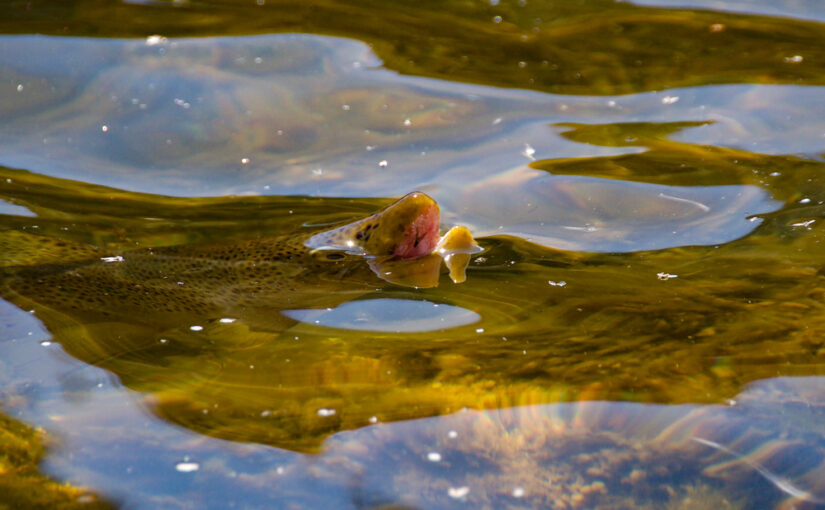
ONE tactic to overcome this situation is creating a fear of missing out (FOMO) in the fish. How do we do this? If you’ve heard of “the induced take”, that is what it essentially does. This is depicted in the header image, where a nymph has been drawn across and upwards in front of a brown trout which is coming in hard to take it. The same effect can be created with any style of subsurface and surface fly.

If a dead drift does not elicit a take, twitch it, lift it, speed it up, slow it down, pop it, stop it, drop it. SHOW THE FISH SOMETHING DIFFERENT, for that is they key. Put the fly in it’s zone, then take it away from it. When fish are not feeding, this tactic will catch you bonus fish.

Best Fishes

SJY

Why You Should Weigh Your Fly Line. Yes, Really!

If weighing your fly line sounds a little technical, it’s really not, all you need are some digital kitchen scales to get a good enough idea. Before we dive deeper into this, you can find introductory information on terminology here.

So what is this fly line weighing about? Helping you fly fish better!

Fly lines are rated using a specific scale historically, and remain so in most cases at the time of writing (see link above for further details). Basically, the rating received for a fly line is based on the first thirty feet of the “head” section. So (for example) if you match a rod rated as a five weight with a 5 weight line (that actually is a five weight line, more on that later) in theory it is balanced. If you then use that to make short casts with only two meters (around six feet) of fly line beyond the rod tip, you will be casting a very under loaded rod, making life difficult. 

The above example is typical of what happens fishing small to medium sized rivers for trout. One good way around this is to use a three weight rod with the same five weight line to improve the efficiency and enjoyment of your fishing IF you are making MOSTLY very short casts. 

However, manufacturers often do this job for you without making a big deal about it (it is often available in a technical information section about a fly line, often on the manufacturers website these days, though sometimes it comes with the fly line still). THIS IS WHY WEIGHING YOUR FLY LINE HELPS YOU! If you take that five weight line and weigh it according to convention, MOST will weigh one to three line weights heavier than standard. The reasons for this are varied and include: —

  • Helps load stiffer modern carbon rods better.
  • Makes casting in many situations feel easier.

The downside of this should you be unaware of it, is impairment of casting performance as your rod becomes overloaded AND a huge negative impact on your presentation. The bottom line of this is, you will catch less fish!

There are many permutations of this scenario, with associated pros and cons. I am not going to work through an exhaustive list here, but to introduce a concept for you to think about in your own fishing. In doing this, you will be able to see situations where Under Lining or Over Lining a rod provide you with positive fishing results!

Best Fishes!

SJY

In the Shade

Have you ever been outdoors on a day when the sun shines in a clear blue sky and does so relentlessly, to the extent that heat, humidity, become uncomfortable, unbearable? If so, did you seek shade? Did you feel the relief of being out of direct sunlight and it being just a little cooler, fresher?

My guess is, the vast majority of people will answer “yes” to the above. So don’t be surprised that fish, particularly cold water species e.g. trout do exactly the same!

In the header image you can see me targeting holding water that remained in shade on a classic blue bird day. I’m also in a shaded area, more comfortable, yes, but that’s not the point. Being in a shaded area, close to the undergrowth and dressed appropriately, I’m less likely to be noticed, or at least tolerated a little longer, by the fish I’m targeting. This is a win/win situation.

Also read this post to help you sneak up on fish.

Thanks for reading!

Indicators

Wondering if this whole piece is just about the topic of “bite indicators” as depicted in the header image? Let me put your mind to rest, NO! What I’m discussing here, is more about bite indication, the various forms we may use and important factors to consider in getting it right.

To put the importance of bite detection into perspective, take a look at this video (all links open in a new tab so you can come back here easy). Okay, the implications of the 1st cast are we miss a fish. The implications of the 2nd cast are “it ain’t taking that fly again anytime soon”. Add in this feature I wrote a while back and it may not be only one fish that ignores your fly! All of a sudden it’s glaringly obvious, how easy it is to blank, if we don’t change things regularly (I hope you can see, not always the fly). When water and light conditions prevent you viewing the fish, which let’s face it occurs on most waters, this whole scenario becomes compounded.

A general; rule of thumb for detecting bites is, the further away from a fly being taken bite detection occurs, the more bites are undetected/missed. So theoretically, whenever an angler can see their fly/fish, we have a potential for 100% bite detection (in reality that does not happen but we can get close with practice). From that perfect situation, bite detection performance falls off very quickly, especially if we don’t do anything to optimise for it (or at least try to). Remember the 2 links above?

So what can we do, when it’s not possible to see a fish eat our fly? I’m going to deal with this in 2 scenarios, 1st using a floating line, 2nd a sinking line.

Using a floating line, it makes sense in some situations to try and detect takes at a point in the leader as close to the fly as is practicable for how we are fishing. This is typically when we are fishing a fly very slowly (a fly moving faster, often hooks fish as they take). In some instances colouring and greasing sections of your leader is our best option. This is not just for euro nymphing rivers, it applies to many lake scenarios too! Another option, when fishing with more than one fly, is rigging a sunk fly under a dry fly. This approach has many names over time. Those that come to mind include wry fly, duo, New Zealand dropper, among others, it’s all the same. When a fish eats the dry, you see it, when it eats a sunk fly, your dry becomes an indicator! Multi fly rigs also have an added bonus which you can see here. Finally where you are restricted to a single fly, need weight in the rig, are fishing rough water conditions, have some form of physical restriction, a combination of the above and/or something I’ve missed, we can attach one of the many and varied buoyant indicators to our leader. Another simple rule of thumb for this is “use the smallest indicator that enables you to achieve the presentation you are aiming for“. The bigger the indicator, the more disturbance it makes, the more obvious it is (fish learn what they are, just like flies) and the greater resistance a taking fish may feel, leads to an increase in ejection speed (it can also act positively, increasing the number of fish hooking themselves at times). When any form of indication within a leader is impractical, e.g. often when using a faster retrieve with a streamer, we can watch the end of our fly line. Where this is not possible, watching the line loop off the end of your rod tip works, before we finally arrive at feeling a pull. By the time we get to this in most situations, you are not seeing/missing the majority of takes occurring.

Fishing a sunk line means for the most part, you won’t see a fish eat your fly or see a take in your line, until you get to watching a loop of line off the end of your rod. There are exceptions to that statement, and my initial rule of thumb for bite detection should be applied accordingly. Sometimes the only option, indeed the best option is to feel for a take. Does this mean we have to miss out on huge numbers of bites? No. Anglers have created many approaches and rigging systems over time to increase the potential for take detection and self hooking of fish through speed/ tension in the line. Rigs like the “washing line” for example. A lot of takes still go unnoticed, so knowing that is also a positive, keep changing what/how you are fishing to give them something different!

Hopefully this helps you think about “indication” to enhance your fly fishing. Can I also make a personal request, to consider ethics. With modern equipment, methods and practice, we can become efficient in the extreme. It’s not for me to tell anyone how they should fish or how many is enough. I would encourage everyone to periodically ask themselves some questions though. It’s healthy for both our sport and our own enjoyment of it!

Have fun!

SJY

A Skill & Luck Game!

Fishing is undoubtedly a combination of skill and luck, based on the successful outcome being catching a fish. Many people overweight the luck element involved, particularly those who catch infrequently. Some people overweight the skill element, and I admit to falling foul of this on occasion. The truth is both luck and skill play their part. Short term, luck may have a greater influence on results, while over time skill has a greater influence. For more context of this on fishing, take a look at this article on luck.

Partly to feed my own curiosity and partly to enable me to help myself and others improve, I digest a varied spectrum of podcasts (more on this here). Since encountering this interview back in 2021, I’ve implemented the concepts to fly fishing, with some very interesting results. I found the whole interview of interest, however if you don’t, the real golden information, from my point of view, is packed into the last hour! Don’t ignore the show notes either and do get the book if reading is your thing!

I’m going to let you glean ideas and information from this rather different resource. I’d never have considered poker as a model that could be used for fishing, without both, having my eyes opened to the possibility AND being open minded enough to accept it!

Have fun and thanks for your interest.

Simplicity

The often quoted “KISS principle” (Keep It Simple Stupid) is as applicable to fly fishing as it is to anything else in life. Most of the time, it gets the job done. If not, THEN we can get a little more complex.

For the last 3 years, I’ve subtracted from the gear I carry while fishing AND from my fishing approach. Why? Simple, to see how little can be done to achieve the desired outcome! It’s made fishing more fun, adding a different type of challenge. If a certain situation needs something more, I can always bring it in. I’ve never carried a lot of equipment waterside, however, it’s now becoming less and less. For 2025 it will be stripped back further. Less choice, means faster, more effective, and focused fishing.

Remember, all we need most of the time is: –

  • Know where the active fish are.
  • Be able to get our fly there, without them knowing we did it.
  • Successfully detect and convert the take!

To achieve this, you won’t need much. So, now ask yourself the questions, How do I achieve the above? What do I need to achieve it?

Have Fun!

SJY

Control – A Key to Boosting Your Success!

One of the key skills to consistently catching, is “control of your equipment!” The effect is so great, it accounts for 30% of your fishing success. So why wouldn’t you want to hone it?

Control is just as important in executing any fly fishing technique as it is in the act of casting a fly line. Below are some examples of practically improving and associated benefits: –

Combining some Stillwater fly fishing outside the river trout season with home based casting practice drills. This process performed correctly will increase your overall casting distance through increasing control of your technique. This is a great achievement on its own. However, it’s also off season over-distance training for the river trout season to come. Your average casting distance on a stillwater is longer than that on a river. So having increased your casting comfort zone (the distances at which you can consistently make high quality presentations of your fly/flies), switching to the river is effectively tapering back to “race distance”. Net result, increased control, accuracy and consistency. Bingo!

Anglers planning a destination trip can find huge benefits in the above casting schedule too. Not just for river fishing either. For consistent success in saltwater fly fishing, many of the key skills required are those needed in various stillwater fly fishing situations. In addition to the casting example above, we can add fishing technique specific examples, such as maintaining tension through the line, hook setting, fish spotting, among others.

River fishing during winter for grayling, chub and pike enables you to practice technique specific skills, particularly nymph and streamer fishing techniques. For example, Euro nymphing methods are highly productive in catching winter grayling. Retaining contact with your fly(flies) is key to maximising takes and take detection (it’s pointless to deceive a fish, if you don’t know about it). Nymph fishing is often the mainstay of early spring success with river trout, when air and water temperatures can be low. So you hit the ground running!

Need some motivation to get you started? Remember the last time you tried to cast that heavy fly only to end up wearing it? Ouch! What about an outing when you knew fish were in front of you and feeding subsurface though you never had a bite? Well maybe you didn’t, however it’s probable you did and failed to detect the take.

Checkout this post and video on practice to help you get started. If you would like help moving forward, take a look at my services here.

Have Fun!

SJY

A.I. in Fly Fishing Part 3

It’s a few months on from my last post on AI in fly fishing and things have continued to evolve at pace. Here I’m going to delve into how we can get the most out of historical fishing logs to benefit our future fishing.

I’ve previously talked about some benefits of fishing logs and modernising them. Moving forward you can use an AI like chatGPT to process a digital version of your fishing log (for example as a PDF), then ask it questions to gain better insights from your previous fishing to help you in future.

One example of this might be to ask “what 3 things are most common when I catch fish?”. Another example approach is to ask a version of “I’m fishing venue, during month, what techniques and flies should I consider based on previous catches?”.

My experiments with this so far, indicate significant potential to me as both an angler and coach. Most of the results are no surprise, but sometimes I’ve found a different way of looking at something, like organising fly boxes to flow through the season. This reduced the amount of patterns I carry by 30-36% making it easier to locate and select what to use. Something like this just helps me make better and faster decisions, by directing me to exactly where I need to look and limiting choice.

The above are only examples, this can be applied too much, much more. But what if you don’t keep a record of your fishing, what use is this? In addition to maybe encouraging you to keep some records going forward and indeed indicate what records may be most useful, you can also use other documentation. For example, some venues publish fishing reports and catch records. You could pull as many years worth of these as you like/are available into a document and analyse it as described for the personal fishing log above. It may help you decipher times, conditions and techniques among other things that are more successful.

It seems the options to improve right now are limited only by our own imagination and desire to do it. I hope this helps and inspires you!

Have fun!

SJY

What is Possible?

Podcasts are what make driving tolerable. I listen to many, generally while traveling to work and back. Sometimes, I find switching off at night really challenging, particularly when we’ve done some really great work waterside with clients.

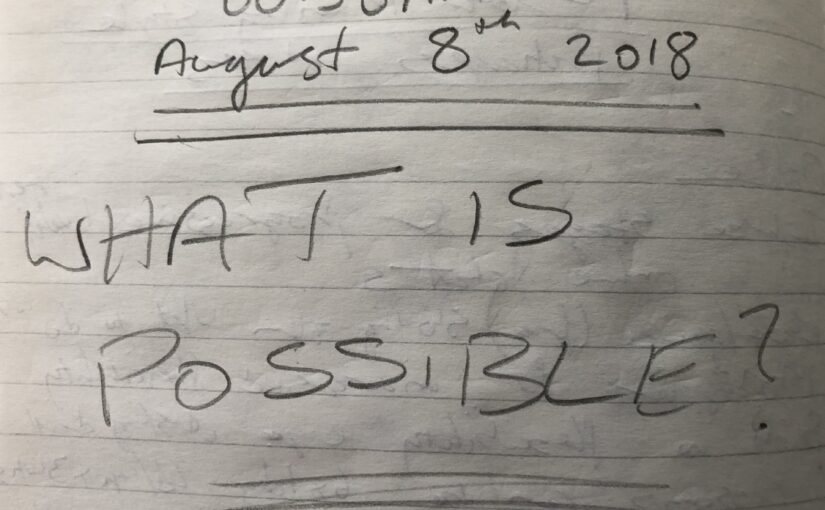
The evening of August 7th 2018 was one such evening. In an effort to calm my mind and chill out, hopefully get some sleep, I put my earphones on and listened to this iconic interview. Not only is the story great and well told, the work put in to achieve his goals was/is inspirational!

I did not fall asleep, I sat up in bed, switched on a lamp and wrote what the image above shows in my notebook at 38 minutes past midnight. That was enough that night. Enough to settle my mind to rest, knowing there was a lot of work to be done!

I recommend listening to the interview for every reason you can think of. April has conducted many fantastic interviews on the Anchored Podcast over years. Andy has gone on to create the Mill House Podcast with his son. Both tell many great stories and among them are true gems of information that can help you enjoy the wonderful world of fly fishing.

Have fun and thank you for your time!

SJY

Depth

 I talk a lot about fish location. To me it’s the most important thing in fishing period. Depth is a factor in that location process. It’s not enough to just know an area, knowing where in the water column fish are feeding is so often the final piece in the jigsaw, the switch that flips the light on!

Amazing video footage yes, but there is more to consider!

In the video above (I’ve used it before and probably will again😁 but here I’m making a different point) the initial take is the important point.Watch carefully, the fish does not react positively to the fly UNTIL IT REACHES THE TROUT’S DEPTH!

So many times when fishing subsurface fish will be aware of and even track a fly that is not at there feeding depth. Only a small number of those actually commit to a take and it’s nothing to do with your fly being wrong. It’s everything to do with your fly being in the wrong place!

This applies equally to dry fly fishing. If your fly sits on the surface and the trout are feeding in the film, your missing out, period.

Overcoming Blind Spots!

Blind spots are behaviours and beliefs that we all develop in our lives. Information we encounter and our own life experience, helps us develop mental databases. Sometimes we are correct and sometimes we are flat out wrong about things. Whether right or wrong, very often it’s holding a belief very rigidly, that is the real thing limiting us.

In my own experience of fly fishing, one of the limiting beliefs I had for several years, was that my fly casting was good enough. Sure, on some occasions that was true. On others, it was the biggest thing holding me back. Once I recognised and accepted that, I decided to do something about it. Actually that last sentence is not completely true! What had to happen was, I had to fail so badly, that it pushed me to become better. (For more on this checkout this post on fear setting for performance by Tim Ferriss. Then reflect on your fishing and perhaps other things too!) This ultimately resulted in a huge leap forward in my ability to catch and significantly improved my overall enjoyment of fly fishing.

Another very common blind spot I encounter in people, anglers and non anglers, is that fish are stupid! No doubt influenced to a large extent by widespread misinformation years ago of gold fish having a three second memory.

Is this belief influencing your approach to fly fishing? If so, you might find this post I wrote previously useful. (Bonus tip: – It’s worth reading anyway😉!)

During 2023 we launched a free online fly fishing assessment tool through our business Midlands Fly Fishing (MFF). The intention was and remains that this tool help fly fishers. So it’s free, the requirement to enter your email is ONLY so your results can be sent to you (MFF won’t spam you) and there is no obligation to book lessons (I would be very happy if you do though🙂). So what does this have to do with “blind spots”? Well, a number of people who used the tool contacted me to discuss coaching. In some cases their assessment answers to all but the last question suggested they were not achieving the outcome they should be, which seemed strange. When I worked with all of these people waterside or digitally, we found something they were or were not doing that negatively impacted there fly fishing.

In every case they were completely unaware of the action. A common example of this, was believing they observe the water to determine location of feeding fish and appropriate tactics to start a fishing session. In fact what they were doing, is setting up with what worked last time and going to a favourite spot to start fishing. Yes, the latter does work. However it was very different to their belief. Making a change here results over time in a huge positive change in angler success (e.g. increased catch regularity)!

Want to review your own fly fishing? Take this short free quiz to receive your own results and see where improvements to your fly fishing will have most impact.

Thanks for reading!

SY

A.I. in Fly Fishing Part 2

One year on from my initial experiments using artificial intelligence (A.I.), progress has been rapid in terms of what we have at our finger tips. What I’m focusing on here is A.I. use to help you improve knowledge acquisition. If you’ve not read the first part of this series, I’d suggest doing so . You can find part 1 here.

Recently I’ve been playing with Google’s A.I. Bard (now Gemini). One area of exploration has been writing prompts for general fishing advice, the sort of thing you might write when looking to progress. Here’s an example: –

My prompt was ” Give me 7 tips for finding feeding fish.”

Result: –

7 Secrets to Finding Feeding Fish

Finding feeding fish isn’t just about casting a line and hoping for the best. It’s about understanding their behavior, habitat, and the clues they leave behind. Here are 7 key points to turn you from a casual angler into a fish-finding master:

1. Know your water: Different fish prefer different environments. Research the species you’re targeting and their preferred habitats: shallows, weed beds, drop-offs, or rocky structures.

2. Time your fishing: Fish are most active during feeding windows, often at dawn, dusk, or during low-light periods. Consider water temperature and seasonal changes that affect their activity levels.

3. Follow the bait: Where there’s food, there are fish. Look for baitfish like minnows, insects, or crustaceans. Birds diving and feeding on baitfish are another telltale sign.

4. Read the signs: Look for surface activity like boils, splashes, or feeding frenzies. These indicate fish actively chasing prey. Pay attention to ripples, disturbances, and current breaks where bait might be concentrated.

5. Utilize technology: Fish finders can reveal underwater structures, fish schools, and even baitfish concentrations. Use them to target specific areas and adjust your approach accordingly.

6. Be mindful of the weather: Wind, rain, and barometric pressure can affect fish behavior. Observe how they react to different conditions and adjust your tactics.

7. Don’t be afraid to experiment: Different techniques work better in different situations. Try various lures, baits, and presentations to see what attracts the fish you’re targeting.

Bonus Tip: Observe experienced anglers. Watch their techniques, where they cast, and what they use. Don’t be afraid to ask questions and learn from their wisdom.

By incorporating these tips and adapting them to your specific fishing grounds and target species, you’ll be well on your way to consistently finding feeding fish and reeling in a successful catch!

My Notes: –

My prompt was very general and not specific to fly fishing. I did this because a good basic answer to this query should be equally relevant across various fishing disciplines and species.

Gemini’s results were really good high level answers. The draft I’ve included above was scripted in the most appealing way to me, however the results were broadly the same for all three versions the A.I. returned.

Some of the results include scope for further investigation. For example tip 1 includes the recommendation to “research the fish species you are targeting” and suggests preferences you should look for. This is great for drilling down further, to fine tune your knowledge.

Overall A.I. is at a point where for this type of knowledge acquisition, it’s very good. Your prompts have to be very relevant to what you are looking for. Though it’s easy to refine them as you go. Doing this you can get in very concise form, all the key information you would find in a good how to style book. The positive difference is results from the A.I. are optimised from a huge database with many contributors, rather than one or two people authoring a book. Yes, both are open to errors. However, on average, for foundation skill type knowledge that has a big fundamental impact, the wisdom of crowds is probably most reliable.

On the other hand I won’t be clearing out my library. Sitting in a favourite chair in front of a fire, on a cold winter night, reading a good fishing book, is one of life’s simple pleasures!

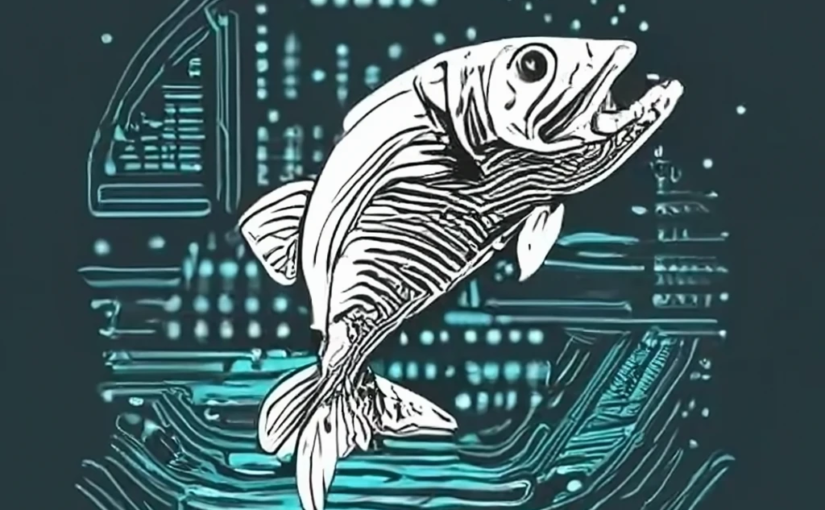
As I said in part 1, view A.I. as just another useful tool in your kit. Remember you are limited only by your own imagination! (The page header artwork was generated using a graphics generator called “Craiyon”).

Bonus Point: – If you found the fish location information in this post useful? You might also like to read this post!😉 (This is the sort of thinking you don’t get from crowds. It’s either a high value gem or a complete failure. I will let you decide which).

Thanks for taking time to read my work!

SY

Feeding Fish – How to Find Them!

So you’ve read a million “X mark’s the spot” type of articles on fish location. Well the good news is, this is not one of them! What I’m sharing here is one tool to improve your fish finding skills. It might be one tool, however it’s a powerful one (as long as you use it😉).

If you accept the fact that a small amount of available water contains the majority of feeding fish, then there is a lot of water, in which fishing is pointless at any one time! Learning areas where fish are more likely to be caught can be speeded up and made much more fun/interesting by water watching. When you see a fish move, ask yourself “why is that fish there?“. Continually ask this question whenever you are waterside, it will rapidly develop your fish location skills!

Now the catch. If you are fishing infrequently/irregularly, this process can take more time. This is no bad thing, just a fact. The good news, you can develop the thinking process away from the water, making the execution habitual when you do fish. How? Checkout this example I do at home below: –

A cropped view from our dinning table.

While eating breakfast, the above image is part of what we see. Many birds are often active in the garden and Andrea will typically mention spotting a robin or wren, they are her favourite garden visitors. If you are wondering where I’m going with this, stick with me. It’s another crazy example to make skill development more doable and hence more likely to be done.

When Andrea mentions “oh, there’s the robin!”, it’s not helping me that much in seeing it. At least, not initially. Over time I noted that this comment from my wife coincided with a robin appearing on the little retaining wall beneath the hedge. Similarly, when she spots a wren it is most often scurrying around the base of the bay tree to the front right.

Learning this, means I rapidly spot the birds even when they don’t hang around for long. Simply because I know where they are most likely to show up when entering the garden. I simply look in the most likely place and most of the time, it’s correct.

Why not develop your own off-water game to develop this skill? Then apply it every time you go fishing to consistently locate feeding fish.

Find this post on fish location useful? You might enjoy this post too.

Hide!

It’s a fact that spooked fish are much harder to catch than fish that are feeding confidently. Key to maximising our opportunity is not being seen. In the header photo two anglers converse waterside. One is wearing a white top and shorts, the other more muted, natural colours. Guess which is more likely to be seen by a fish?

I’m not saying the act of wearing a white top and shorts will automatically scare fish (it depends on how knobbly your knees are😁). Light/bright, reflective surfaces simply make any movement you make more noticeable. Hence you are more likely to spook fish.

fishing with a bright coat.
I get it wrong too!

Travelling to fish during winter I left home early and it was cold. I put on my cosy padded jacket and loaded my gear in the car. Bottom line, I left my fishing jacket at home for some inexcusable reason. I had to fish this extremely clear venue in the bright blue jacket all day. Did I blank? No. However I did see rather more fish depart for the depths than usual, reducing my opportunities significantly.

Want to know more about remaining hidden from fish? Checkout this feature on footfall.

Big Landing Nets

If landing nets don’t rate highly on your priority list of fly fishing gear and gadgets, let me ask you this one question. Have you ever felt intense pain at losing a big fish? Yes? Read on. No? Read on, you may yet be spared!😉

On average you are more likely to part company with large fish during the first and last ten seconds of battle. 8/10 losses in the last ten seconds result from nets being too small. Let’s look at two examples of this.

A few years ago a long time regular at Loynton Lakes had an ambition to catch a 20lb+ trout at the venue. He spent significant time and effort in this pursuit and I suggested to him that upgrading his landing net would enable the netting of his target fish, when the time came to go much better. Unfortunately, my words were not taken seriously until the person concerned hooked and lost his prize during attempted netting. What went wrong? Yes, you probably guessed, the net was too small for the fish! Following this experience the net deficiency was corrected. Late, yes. However there is a happy ending. He succeeded in landing not one but two rainbow trout exceeding 20 pounds in weight during seasons that followed and continues to own a big landing net.

Mayfly time is renowned for luring large river trout to the surface and this year was no different. In the photograph above you can see a quality trout in my landing net recovering prior to release. This fish and several others had to be played very hard in confined space and netted quickly for a successful landing. Also better for fish survival. The net used and shown is a short handled salmon net, to give you some idea of scale. Using this for my own river trout fishing and guiding ensures I can always efficiently net fish myself and for my clients. While a typical pan style river net is fine for most fish, netting large fish is a struggle, why take the risk when eliminating it is so easy?

Large net’s also benefit fish welfare. More space means the chance of crushing vital organs is minimised, maximising survival rates for released trout. Finally, if you are concerned that a large net is less maneuverable? Remember, when netting fish, the fish should be brought to the net, not the other way around!

I hope this gives you some thoughts and ideas enabling you to land more big fish!

SJY

A.I. in Fly Fishing

We are no doubt just starting to scratch the surface of possibilities in working with Artificial Intelligence (A.I.), in all walks of life, let alone fly fishing! Saying that, this is all about fly fishing.

Early 2023 saw me “playing” with some A.I. platforms. Experimenting in as many ways as I could think of at the time, with what was then available. Since then I’ve had my eyes opened to other possibilities and the technology available to Joe Bloggs has evolved at an astounding rate.

Bearing all this in mind here are a couple of examples from my early trials, my results and my own thoughts for them. For context, these experiments were conducted during January 2023. First is the “prompt” I gave to the AI, second are the responses from the AI.

Task 1: – Give me 5 ideas for uk fly fishing in May.

  1. Visit the River Test in Hampshire: May is a great time to visit this famous chalk stream for fly fishing. The River Test is renowned for its large brown and rainbow trout, and the Mayfly hatch can provide some exciting dry fly action.
  2. Try Stillwater fly fishing: May can be a great time to target stillwater fisheries in the UK. Many lakes will have had their first stocking of the season, and fish will be active and feeding. Popular stillwater fisheries for fly fishing include Rutland Water, Grafham Water, and Chew Valley Lake.
  3. Target Sea Trout on the Welsh Dee: May can be a good time to target sea trout on the Welsh Dee. These fish are known for their aggressive takes and acrobatic fights, and can provide some thrilling sport on the fly.
  4. Visit the River Usk in South Wales: May can be a good time to target the wild brown trout on the River Usk. This river is known for its scenic beauty and excellent fly fishing, with dry flies being particularly effective during the spring months.
  5. Try saltwater fly fishing on the South Coast: May can be a good time to target a range of saltwater species on the South Coast of the UK. From bass and mullet to sea trout and pollock, there are plenty of opportunities for fly fishing in the salt during the spring months. Some popular locations include the Dorset coast, the Isle of Wight, and the South Devon coast.

Task 2: – What 3 flies do I need for trout fly fishing on a  English chalk stream in May?

  1. Mayfly Dry Fly: The Mayfly is one of the most iconic hatches of the season on chalk streams, and can provide some exciting dry fly action. Patterns such as the Grey Wulff, Green Drake, and Adams can be effective imitations of the Mayfly.
  2. Pheasant Tail Nymph: The Pheasant Tail Nymph is a classic fly pattern that can be effective for imitating a range of aquatic insects found on chalk streams, including mayfly nymphs, caddis larvae, and stonefly nymphs. This fly can be fished with a variety of techniques, including nymphing under an indicator, or fishing it on a dropper below a dry fly.
  3. Klinkhammer: The Klinkhammer is a versatile fly pattern that can be used to imitate a range of emerging insects, including mayflies, caddisflies, and midges. This fly is designed to ride low in the water, with the body of the fly hanging below the surface, and the hackle and wing sitting above the surface, creating a realistic profile that can be irresistible to feeding trout.

My Notes

For task 1 it took the A.I. 5 regenerations to get all 5 answers this relevant. They are not up to a standard I would be happy with yet, however they are at least not breaking any rules. Previous 4 iterations had good suggestions, but contained too many errors e.g. 1-2 options that were out of season in May.

Task 2 however the AI came up with all 3 options that would be acceptable and would accommodate the average fly fisher on 1st iteration.

As you can see there is a long way to go. Even with this limited and simple task set, the variance is huge in relation to answer quality. At the moment a degree of your own knowledge is required to validate answers from the AI. It’s easy to further refine results with further prompts and learning to ask better questions. With time and practice, the results get better with you. Rather like your fly fishing😉.

The Future

The possibilities for using artificial intelligence within fly fishing from the perspectives of both anglers and the industry are huge. Trip planning, tackle selection, advice, learning, equipment design, and much more can be taken to another level.

Will it make me redundant? Maybe. However, it’s much more likely to do exactly what many other new technologies have done. That is become another useful tool to add to my box of tricks, enabling me to help people get better at and more enjoyment from the wonderful sport that is fly fishing!

Why Summer is Like Yo Sushi for Trout!

Fly fishers have long bemoaned summer time as “the dog days of trout fishing”. This need not be so!

I’ve written previously about issues of oxygen levels/water temperature, here I’m going to talk food. The bottom line is, summer is a time of plenty. This simple fact is often seen as a negative by fly fishers, fish are picky, satiated, lazy, it’s difficult, etc. However with a little thought, this can be quickly turned into a positive advantage for the fly fisher.

Firstly pick your water. Rivers and lakes at higher elevation are often cooler and food for trout is in shorter supply (generally speaking, there are exceptions). In these instances trout will be keen to make the most of any bounty in order to survive leaner times. Spring fed lakes and rivers are my other go to during summer. Yes, there will be lots of food for trout, but cooler temperatures see them feed well at key times and where the water is clear you can place your fly closer to feeding fish. Where the water is coloured, we can adopt other tactics to increase our chances.

Then pick your times. Early and late are classic times to fish during summer for good reason. There is no need to rewrite the rule book here. One addition I make however, is for lakes, morning is often better than evening these days. This is because the water is much cooler.

In all cases you are going to contend with huge amounts of natural food. If your fly is not right in the trouts feeding zone, it might as well not be in the water! Summer time is Yo Sushi for trout, the food is rolling along in front of them, to pick at as they like. Fishing in the right place at the right time turns the table to your advantage. Remember this and have fun!

The Shooting Stick Philosophy

Ask me what really excites me about going fly fishing and I will respond with the term visual fly fishing. Asked to expand on this, I’ll say observation of the water, surrounding environment and conditions to locate feeding fish, stalk a selected fish I want to catch, then watch it eat my fly. That’s what does it for me!

So when I read “Chalkstream Chronicle” by Neil Patterson in my early twenties (an excellent book for many reasons including, highly entertaining and far from just a book for the chalk stream fisher), a chapter that shares the same title as this post stuck in my mind.You don’t need an actual shooting stick of course, just take up a position that gives you a great view over a good length of water best described as fishy (your watercraft tells you this), make yourself as unobtrusive as possible, then simply wait and watch. The longer you do this for, the more you see.

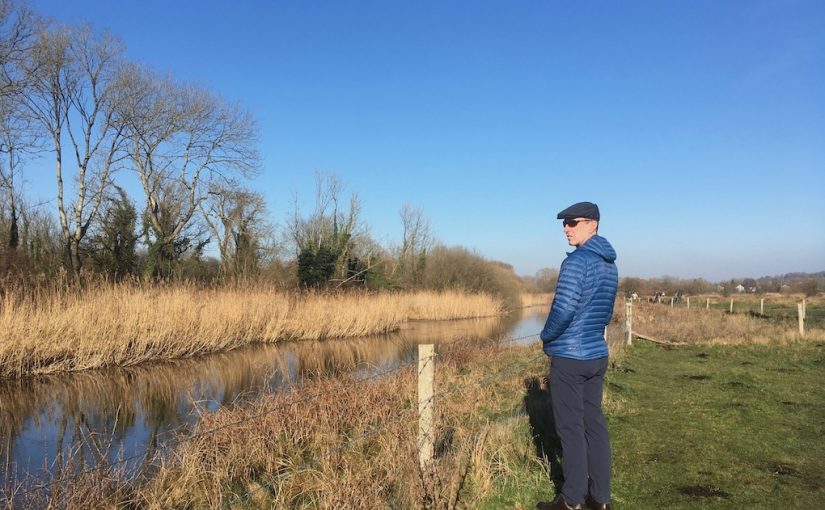
The above image shows me doing exactly this during a winter walk with my wife. I’m not exactly camouflaged, however I was warm, enjoying winter sunshine, fresh air and being close to water. We took our post lunch river walk to coincide with the best chance of a sparse olive hatch that might just get a fish or two to rise, even on a cold day in early February. All parties obliged and by waiting and watching over this long, flat glide, we identified the holding spots for some fine trout and grayling. All this is now logged for future use and it was fun to practice for the season to come.

Of course, on most waters there are many days when you see no sign of a fish and search tactics make sense. However, when feeding fish do offer clues to their whereabouts and what they may accept from us fly fishers, a shooting stick approach is generally more productive. Indeed if you found my initial paragraph of this post intriguing, you will probably derive far more fun from employing this tactic too.

Why not try a shooting stick philosophy this season? Have fun and let me know how you get on.

Best Fishes

SJY

Creating a Powerful Fishing Log with the Apple Notes App

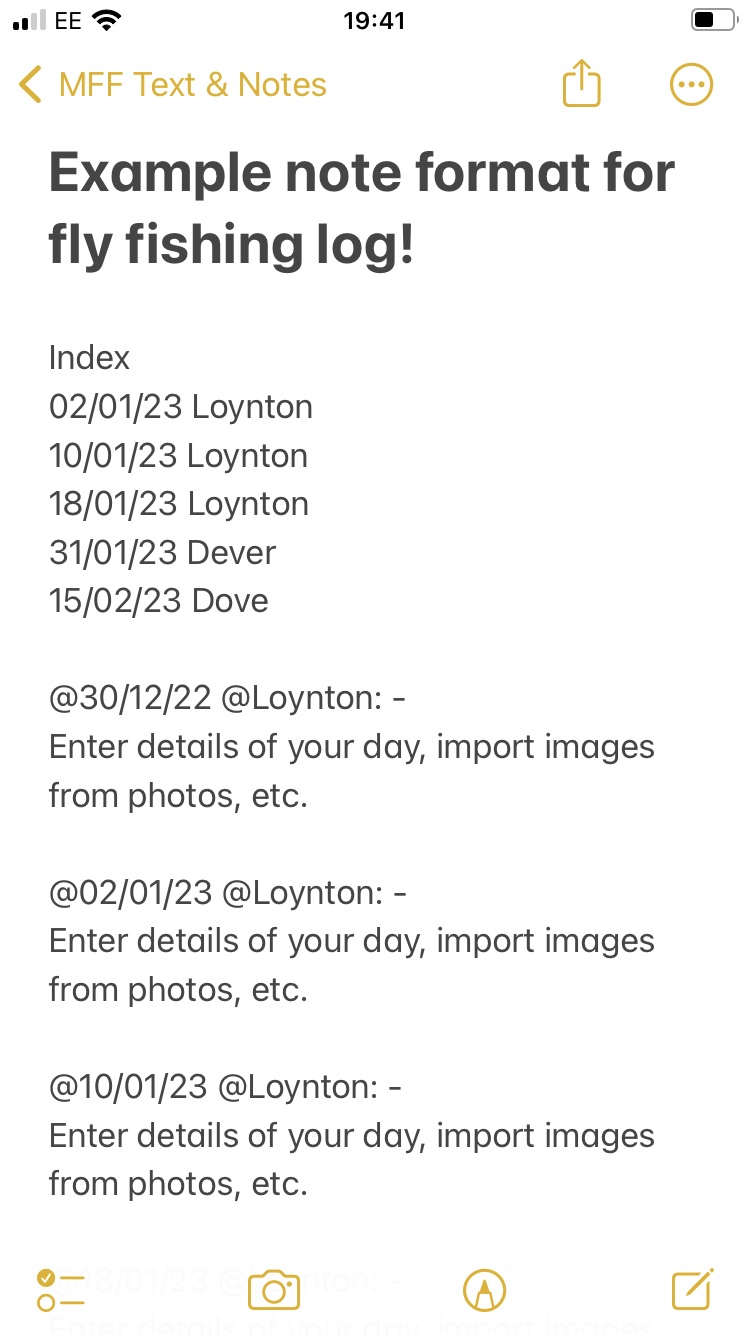
In previous posts extolling the benefits of harnessing technology within your fishing, I’ve touched on using phones to generate effective, always at hand fishing logs. Since Apple added the “@” tag into their Notes app, I’ve been using it for the creation of simple databases, using this puts your fishing log on steroids!

This simple configuration consisting of fishing date and venue in the index serves as a guide. The same information is then repeated as a title of your entry with “@“ before both the date and venue, allowing searches to be date based and/or venue specific. Simply click the circle with three dots in it (top right corner of phone screen), then select magnifying glass icon, enter search term e.g. “@Loynton”.

With time this evolves into a very powerful tool, especially if you take the medium and long term perspectives. E.g. compare month on month across years. Look for winning combinations at certain seasons and/or venues, spot patterns to improve your fishing and results, etc. You can even share it with fishing friends, each of you making entries in different colours to share experiences and build the database faster and better.

These are all options, try it, play with it, see what you can achieve and above all have fun!

SJY

A Mayfly’s Story

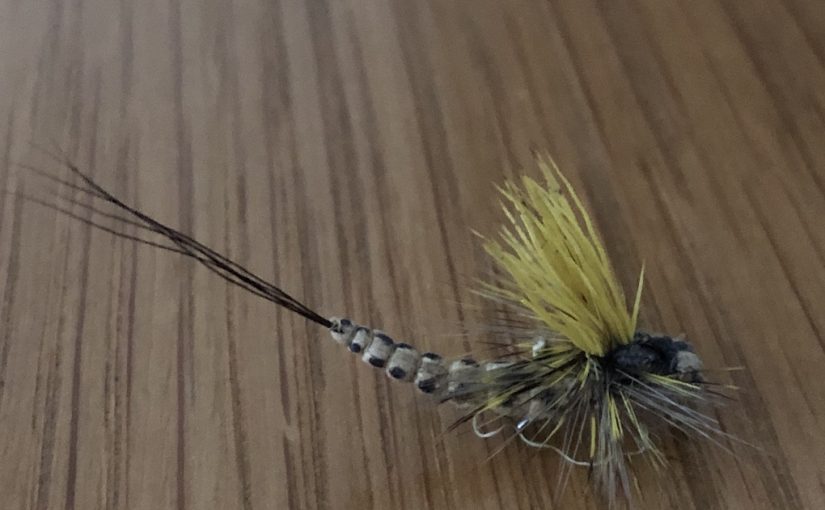
The Mohican Mayfly (see image above) has featured in my mayfly box ever since Oliver Edwards released the pattern many years ago. For perhaps 3-4 years it’s popularity gained momentum, however it remained a pattern you could rely on with tricky trout, those that had seen ‘nearly’ everything. Then the fly was everywhere and lost its edge.

It remained part of my mayfly team however. The pattern is robust, needs little TLC when the hatch and rise are really on and is ideal for less experienced fly fishers, being nearly unsinkable. It’s nearly perfect, but fails my key rule of top guide flies, in that it takes quite some time (for me at least) to tie. For this reason, I pay someone else for that job. A fly that I’ve spent 30+ minutes tying, won’t get thrown into snag holes with quite the same conviction and when a client looses one, (as they inevitably will or they are not trying hard enough) it induces physical pain. Hence life is better this way!

This particular fly, had a rather special journey during May/June 2022. I fished or guided on days where mayfly hatches triggered trout to surface feed, from May 2nd until June 17th. The Mohican Mayfly produced fish throughout that time to the point where some ‘secret weapons’ were not called upon for duty. It seemed the pattern had recaptured some of it’s former magic! Perhaps it had lost favour with other anglers, I don’t know. It sure worked well for us.

mayfly brown trout
My largest brown trout of Mayfly 2022 caught on the Mohican Mayfly.

This one fly is special. It was the first to be tied to my leader on May 2nd. I caught many trout on it, including my largest brown at mayfly time during 2022. It was also regularly tied to the leaders of clients, many of whom did well with it. Having been rescued from many branches, bushes, nettles (ouch), a client finally lodged it firmly in a tree branch on June 15th. I recover all the flies and leaders I can from snags, but I had become rather attached to this, not so little fly in particular. We were not going to part company and I would not leave it in a tree. I went into monkey mode and managed to rescue my feathered friend. However it had lodged deep into the branch and in freeing it, I snapped the hook at the bend. Part metal fatigue maybe, ham fisted clumsiness from me almost certainly.

So it now resides by my tying desk as you see it. This winter I will frame it with the picture of the brown trout, then it will take it’s place on my office wall of fame.

Tight Lines & Best Fishes for 2023!

SJY

By continuing to use the site, you agree to the use of cookies. more information

The cookie settings on this website are set to "allow cookies" to give you the best browsing experience possible. If you continue to use this website without changing your cookie settings or you click "Accept" below then you are consenting to this.

Close