Five Winter Fly Fishing Tips!

Whether you are grayling fishing on rivers, trout fishing on lakes or pike fishing on either this winter, these 5 tips will help you.

When to put it there – Focus your efforts between 11AM and 3PM. 8/10 days, this gets it done. Temps are highest during this time frame and so is fish activity generally.

Where to put it – It’s vital to present your fly at the feeding level of the fish. Whether that’s bottom feeding grayling on the river or trout cruising and feeding on a lake. The closer you get your fly to the fish’s mouth, the more it eats it! Don’t just think your fly is in front of fish, make sure it is.

If you are nymph fishing for winter grayling, your fly should snag bottom every few casts, if not, you are not fishing deep enough (Same holds true for pike on streamers). When you trout or pike fish lakes, vary drop time between casting and starting your retrieve. If you always start retrieving your sunk flies immediately, you are massively limiting your opportunity to catch.

Layer up – keeping warm and dry is going to help you fish well. You stay mobile, enthused and have fun for longer.

Food and fluids – Works with keeping warm. Hydration and blood sugar make fishing easier and fun. The longer you are having fun, the better!

Finer & Lighter – using tackle systems which are as light and fine as practical for your fishing, makes a major improvement to your catch rate. Winter time water conditions can be very clear and takes can be more subtle in cold temperatures. Lighter gear really helps take detection!

Have fun!

SJY

5 Tips to Improve Your Stillwater Fly Fishing!

If you caught trout 8 out of 10 fly fishing days, would you be happy? That is my initial question to you. If your answer is yes, read on, I have some very good news.

If your answer is I already catch that number of times, great, well done. Perhaps now it’s time to consider if you want to take it further or are you happy where you are?

Very simply, by focussing on a very few key points and executing them well, you can achieve that goal of consistent success surprisingly quickly and have fun!

Click here to find out how you can improve fast, for free with this online tool!

Where many of us go wrong is just getting too excited. If we’ve not fished for a while, it’s easy to anticipate the coming of a fishing day. Very often this leads us to rush and start too quickly. Note I have omitted the word “fishing” from the previous sentence, that’s because we are more likely to be “fish scaring”. To start stepping past this, here are my key points for rapid progress: –

  1. Respect: – Trout reared on a farm and introduced to lakes are not stupid, they are just naive when initially stocked. They adapt to evade anglers fast as a wild fish does. Respect your quarry, it will give your fishing purpose. Without it consider asking yourself “why am I here?”. We are supposed to be having fun!
  2. Find Them or Forget It: – Spend time on arrival observing the water. Walk the water if you don’t know it well, looking for “fishy” spots and signs of feeding fish. Choose vantage points that maximise your view to speed up the process. Ensure you take time with this step, your ability to locate feeding fish is the most important factor in catching trout. This process is harder in lakes than rivers as many of the signs are more subtle, leading to the mistake of seeing lake fly fishing as chuck it and chance luck. Know it is not! It just has some different skill sets to river fishing as well as many commonalities.
  3. Casting: – The most frustrating thing in fly fishing is to know exactly where trout are feeding, how to catch them and be unable to put your fly where it needs to be. I remember going through this and having tried various solutions can advise you definitively, your fastest route is book a casting review with an instructor. You should come away with a plan to improve. Then crucially, practice! It will surprise you how fast your rate of progress is and how little time it takes. Making the effort to do this enables you to focus on fishing when waterside, casting is in the bag!
  4. Presentation: – Points 2 & 3 feed into this. Observation enables you to make better decisions on equipment you need and assembly to fish appropriate techniques. Casting enables you to put a fly on the trouts diner plate, preferably without it knowing you put it there! This maximises your chance of receiving a take, it also needs to maximise bite detection, otherwise it’s pointless.Time spent with successful stillwater fly fishers willing and able to impart tactical advise waterside is priceless here. For example, lowering your rod tip could quadruple your hook ups!
  5. The Head Game: – Competence breeds confidence, it’s as simple as that. Focus on the above key areas of your lake fly fishing and track your progress, it’s great fun. Take every opportunity to learn more. There are learning resources in multiple formats everywhere, so seek them out and see what works for you.

I provide coaching options for clients in both on the water and digital formats should you want help with this process. Simply drop me a line to discuss your requirements.

Best fishes & have fun!

Steve Yeomans

Midlands Fly Fishing

Five Summer Fly Fishing Tips

Fly fishing for trout during Summer provides the angler with fabulous sport provided you adapt to a new set of conditions. Here are 5 tips to boost your success: –

1. Water temperature and the resulting oxygen levels are vital, so venue selection is key. Spring fed rivers and lakes are a huge advantage as are high elevation waters where the temperature may not be as high. Here you are more likely to find actively feeding trout.

2. Fish when the trout feed. Summer time often means fishing during the cooler parts of the day to maximise your chance of success. Morning and evening are prime time!

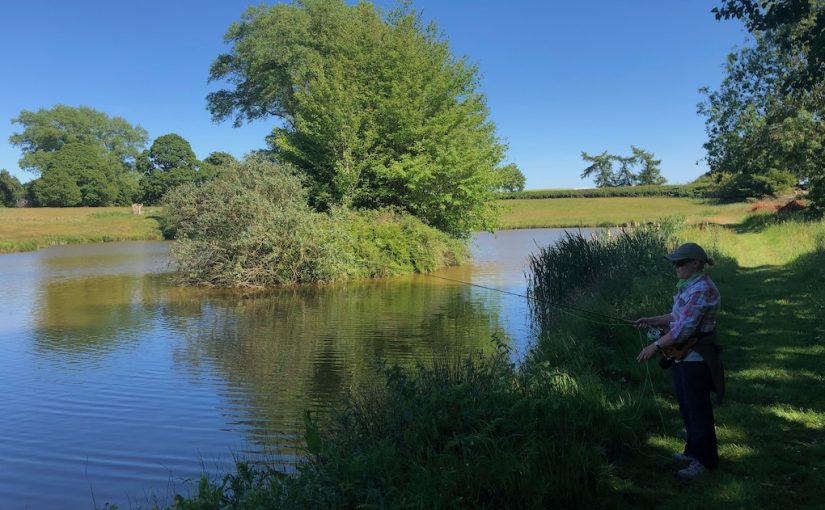
3. Do something different. In the above photo Andrea went and dibbled a dry fly along a shaded overgrown bank during a hot, sunny day. It was cooler here, the fish felt more confident due to shade and less fishing pressure. The restricted back cast put most anglers off this spot, Andrea roll cast to overcome this. A fish was caught on her third cast! Whether you are fishing lake or river, putting your fly where fish feel safe is a good way to achieve success.

4. Where you are allowed/able to consider using more than one fly to up your chances of a take. Summer is a time of plenty for trout!

5. For the same reason as point 4, wherever you can see a fish, get your fly as close to it’s feeding zone as possible. Doing this hugely increases your chance of a take. Checkout this short video below in addition to the link above. Note it’s just as relevant to rivers!

Wishing you fun on the water!

SJY

One Plus One Does Not Equal Two!

Your initial thought on reading the heading of this post might be something like ” Steve’s maths needs some work”! That maybe so, but not for the purpose of this post. You see one of the challenges in summer fly fishing is the time of plenty. In many waters trout have a diversity of prey that is available in volume and much of it easily obtainable at times.

What does this have to do with maths?

Well for my personal fishing I am keen to use 1 fly for most of my fishing, often for no other reason than I enjoy it, sometimes because it is more effective. However, summer time fish food abundance means that fishing more than one fly where fishery rules allow, really ups your chances of catching trout. Particularly in scenarios where it is not possible to see fish in the water.

An example of this is using a dry fly with a nymph dropper on lake or river. Most peoples initial reaction is that using two flies rather than one doubles your chances. This is wrong! Yes a trout could see the dry fly and take. Yes a trout could see the nymph and take. A trout could also see the dry, not take it and eat the nymph or vice versa. So moving from one fly to two flies at least quadruples your chance of getting a bite, if you are fishing in the right place that is! Play with this concept during summer.

Custom fly rods – A case for having one!

While I think the quality of entry level/budget fly rods offers amazing value for money today, I’ve been questioning whether premium rods now offer fly fishers a good option or if your money is better spent elsewhere. Here’s what I think based on looking at choices from a mainly performance perspective, while allowing for the fact that nice stuff is well, nice!

Firstly, a new or inexperienced fly fisher rarely has the skill level to appreciate a premium, high performance fly rod. I remember hating them with a passion at one time, many were too stiff for the close quarter fishing I loved and still do. However the bottom line was, back then my casting was simply not good enough. It’s like learning to drive in an F1 car, only less lethal! Early days a budget level rod is more forgiving of our mistakes while providing adequate performance.

Beyond this however, we can appreciate the potential benefits offered by higher performance rods, for which we pay a higher price and rightly so. The question for me was, is it better to go with an “off the peg fly rod” or have a fly rod custom built?

I have accumulated a number of high spec fly rods (as you do) over many years, with the usual justification of wanting them for specific times, places, techniques, etc. Following my own advice of always try before you buy when it comes to fly rods at this level, I’ve been largely pleased with the results. When it comes to pricing, it’s like anything else in life, if you are happy to pay X for the rod and are pleased with your purchase, that’s all that matters. However, in some instances, we can have our cake and eat it!

With custom built fly rods, the fact you can have elements styled to your taste so it’s nice to own is certainly true. The big opportunity in having a rod made, one I’ve found hugely beneficial is in performance. The key here is in knowing what you want the rod for. When I was 18, I built a fly rod for fishing tiny overgrown brooks. Not long after, I had a pair of fly rods built specifically for reservoir boat fishing. More recently I’ve had the rod shown in the above photo built by Andy Banting. The general spec of this rod is a 9ft 5wt. Testing on the casting field shows it works well with lines of 4-7wt with the sweet spot in the 5-6wt range based upon line rating to the AFTM scale. This means it’s ideal for small to medium sized stillwater, while being perfect for casting larger dries and/or blustery days on the river.

I didn’t have this rod made as a general tool though, it was designed for stalking or sight fishing. Key for me was minimising rod flash, so the blank is matt, there is no flashy decoration or exuberant colours. I just want this rod not to be seen when fishing and we did everything to help it blend into the background. Blank performance was critical, quick and accurate with a soft tip make the perfect fishing tool in this instance for me. I can put the fly where I need to (most of the time), have the power to control and quickly subdue large trout, while having the cushioning effect to guard against that sudden out of the blue savage run. The handle is purpose made, nicely decorative, yet functional. You see I have shovels for hands, so the handle has been made thicker than you find on an off the peg rod. This makes it more comfortable for me to hold, over the course of a day it’s less fatiguing on my hand, this also helps keep my casting arm relaxed and is another huge win!

A significant number of clients I see for casting lessons exhibit what at first glance can be considered a fault, over powering a cast. However, this can also be what I’ve come to regard as a symptom. An angler hitting the cast too hard while having white knuckles on the casting hand is a classic sign that the grip is too tight and might be causing the over power issue. One cause of this is an inappropriate rod handle for the angler concerned. This is an under explored aspect of fly rods. To see the potential, look at what is done with golf clubs, it makes a difference when you get it right.

For any fly fisher wanting a special rod I say this. If you want a high performance rod as a general fishing tool, an off the peg rod might be your best option. For anyone who knows what they want or is willing and able to work with others to discover that, a custom built rod is undoubtedly your best option performance wise and you get to make it look nice for you too. Another bonus, having your cake and eating it saves you money against top off the peg rods with big brand marketing budgets!

If you are considering a custom rod, Andy Banting built “The Heron” (and it’s lighter 3wt cousin “Excalibur”) for me. You can look him up at Drew Fly Rods, where you will find images of rods he’s built, what he can do for you and contact details.

Interested in optimising your setup, casting or understanding what you need from a rod for your own fishing, drop me a line here.

Best Fishes

Steve
Fly Fishing Observations from Coaching Groups

One of the fantastic benefits of working with groups of fly fishers, is I get to run experiments. Not on the anglers (in case you wondered) but to test situations which we collectively (I am at least as susceptible to this as anyone) might draw (and often do) the wrong conclusion. So if nothing else, to satisfy my inner lab rat, I started to monitor the findings. My results over 2 years on lake and river make some thought provoking reading.

There are times during the day and indeed year when little standout fish activity is visible. During such periods, having multiple people fishing means we can try different tactics to see what works. When one angler starts to receive takes in a group under such conditions, it’s very natural to conclude we’ve found “the” solution and switch everyone to that setup. If everyone is then successful, we can all pat ourselves on the back, thinking we cracked it, but have we? Equally, if no one else is successful after changing, then the angler who is successful just got lucky, but did they? The answer to both scenarios in most cases is no!

Why? In scenario 1 everyone enjoys success doing the same thing. It could be that fish started to feed after a dormant period, so everyone changing coincided with this. What I found is very often, keeping everyone fishing differently resulted in success too. How do I know? Sometimes we swapped to one technique then swapped back to check if there was a difference. We also did this in reverse sometimes.

In scenario 2 only the original successful angler catches, are they just lucky? Again the majority of the time no is the answer. Very often the “lucky” angler is the one fishing where the fish are! Remember rule number 1 is know where the active fish are.

A personal favourite scenario, one I fall foul of regularly is “selective feeding”. It’s super satisfying to observe what food is available and fish subsequently eating that food. Selecting a fly that we label as suggesting the same food item, we cast and are subsequently successful in catching a fish. Therefore that fish took our fly for X! Well sometimes it did and sometimes you could have thrown anything to it. With multiple anglers fishing the same situation using different flies and sometimes different techniques, most of the time fish take more than the option perceived to be selective.

What drops out from all this is, putting a fly that looks very generally like food where the fish want it, when they are active, will bring success most of the time if executed well. A very worthwhile strategy for anyone making the most of limited fishing time!

Best fishes

SJY

Inspiration

With a new year looming, a new season will eventually come around for our river trout fishing. Meantime, I thought I’d share a little gem to help inspire and motivate you for the fly fishing year ahead.

Earlier this year, Scientific Anglers released some of their archive video with top anglers from back in the 1980’s. Some of these videos back in the day, were both inspirational and helpful to my own journey. Here’s one I think may really open your eyes to some possible development opportunities in the coming season. If you don’t find a gem among this, your either very good or need to watch it again😉

Best Fishes

SJY

Avoid Frustration!

One of the great fly fishing skills is knowing where to put the fly. The greatest frustration in fly fishing is knowing where to put the fly and not being able to put it there!!

The above image shows me delivering a nice cast to target, having identified that magical nervous water. It has not always been that way.

We all have to start somewhere. For me that was a small stream holding wild browns. If that sounds idyllic, it’s not when your casting is inconsistent, your wrist thrashes around, your timing is off, the line is out of control. In wild places, this means your fly spends more time in undergrowth than water. When it lands on water, it’s often with the grace of a house brick! Frustration was the word.

Having overcome my casting issues on stream (or so I thought) I caught an increasing number of beautiful browns. When I started to visit a couple of lakes, I found catching trout patrolling margin areas great fun. I was also successful regularly. However if a fishery is busy, trout generally move further away from banks. You guessed it, my self taught, small stream casting technique was not up to the job. At around 40 feet I’d tail the loop perfectly every time. Argh, the frustration!

This is where we come to a fork in the road! On one side we fail, give up and drop out. The other way leads to life long learning, enjoyment and ultimate success. When I want to do something, the latter route is always going to be my chosen path!

I’ve said before, I like finding things out for myself. That can be a very slow route for some things, though highly rewarding if time is on your side. It dawned on me that I needed help, I followed much of my strategy outlined here in order to, in this instance, transform my fly casting.

This single action combined with subsequent practice made all the difference to my enjoyment of fly fishing, my success and creating a platform that ultimately led me to now.

Playing a fish!
Success! The result of putting a fly where it needed to be.

If you can identify with some of the above journey, I hope you’ve found encouragement to move forward with your fly fishing. Modern learning methods mean you can shortcut the learning curve more than ever. If you would like know more, join me here.

The video below is an example of a fantastic adaptation to deliver your fly to where it needs to be.

Have fun!

SJY

Choice

If you’ve ever walked through a retail store or e-commerce website and felt overwhelmed, you are not alone. It’s one of many sales strategies used to get us to buy more. Based on the theory that when faced with huge choice people buy more just in case and because they are confused and don’t want to get it wrong.

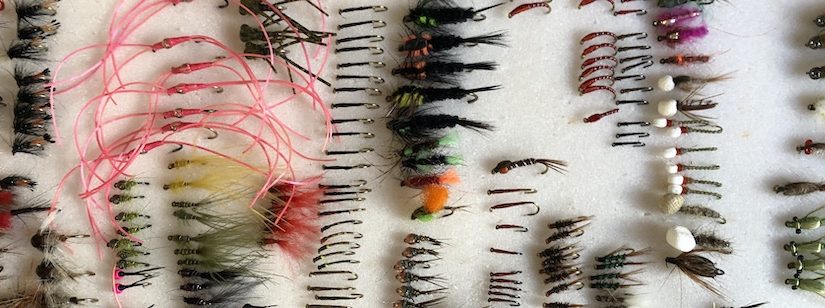
The same physiological function also acts against us when waterside, gazing at huge fly selections, accumulated in the fly box(es) we carry. The above image depicts a lot of choice, multiple different fly patterns. More often than not, a good quality suggestive fly will be good enough. If you accept that, then a small selection of fly patterns, with some size, colour and where relevant weight variation will help you. Spend more time fishing confidently, less time dithering over what fly to fish. This video shows a basic sample of flies I’m talking about!

A further development of this selection, including, useful size and colour variants can be found here.

Try building this approach into your general fly fishing, especially if you only fish a few times each year. Most of the time, it will pay you back handsomely!

Thanks for reading.

SJY

4 Most Popular Fly Fishing Posts

It’s been 5 years since I first posted here and a little while since I wrote a post, we are having a wonderfully busy guide season. So here are 4 historical posts which have proved most popular and useful over time. If they look familiar, now is a good time for a review. If you are finding them for the first time, I hope you find them useful and enjoyable.

3 Great Dry Flies

Luck

Stillwater Fly Fishing Podcast

Improving Your Fly Fishing

Best Fishes

SJY

Listen!

It’s easy to get carried away in the moment, becoming over excited, keen to impress, especially in special situations. I’ve done it myself, missing key opportunities that can make a big difference. Checkout this short video, it’s not really just about salmon fishing!

Thanks for reading.

SJY

Presentation – Part 2

In Part 1 we looked at the impact of presentation both +ve and -ve. Here we take a look at a key component of getting it right, using appropriate equipment setup for a given situation. While the core focus of the video below is leaders, we also show the importance of pairing the whole setup for maximum fishing efficiency and enjoyment using a number of common examples.

Note, while this video is filmed in a river situation, it is equally applicable to others. For example lake or saltwater and use of a double hand rod!

Thanks for reading.

SJY

Add Distance to Your Fly Cast Quickly & Easily!

A quick and easy tip to keep your fly line flowing smoothly through your rod rings when casting is to clean your fly line regularly. During fishing dirt sticks to your line. If you don’t remove it, your equipment will not perform optimally.

Simply carry a clean micro fibre cloth with you when fishing. At the end of your day, wind the line onto your reel through the cloth. You’re done. This simple action routinely adds 10 feet+ to my clients casts.

For a more thorough cleaning and line rejuvenation, watch the video below.

Presentation Part 1

Presentation is a combination of actions that ends with your fly in the water. Correct execution means your fly is presented in a way that triggers a fish to bite it and enables you to detect this action. Conversely, poor presentation is more likely to result in a fish rejecting your fly OR the take not being detected.

The 3 videos below show fantastic examples of good and bad presentation, fish responses and fishing outcomes. I’ve included these clips to cover Salmon, Trout and Carp. This not only increases relevancy to more fly fishing situations, it also shows very clearly some major similarities across species and techniques.

21 seconds that could transform your fly fishing! See takes you never knew you had. A clip from Stillwater Fly Fishing, see vimeo.com/ondemand/stillwaterflyfishing

Footfall

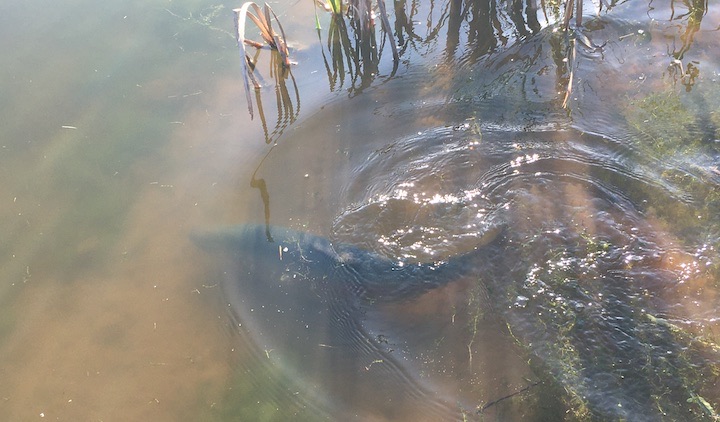
See the big trout in the header photo, exiting stage left? Yes, it spooked, though not on this occasion because of me. I’d sneaked into position to watch it nymphing. I was just going to film it, when it suddenly bolted. Thirty meters away 2 anglers were stomping towards me, oblivious to any of this and a trout they were not going to catch anytime soon.

Ten plus years ago I regularly ran lessons and events at a very clear stillwater that held a good number of resident brown trout. Some of these fish were substantial in size and very desirable to catch. During the main part of the day I hardly ever saw them. However I regularly saw them early morning. I could see them cruising the margins, hunting crayfish. So I could stalk select fish and lay an ambush. The problem was initially, I could not get near them. I had plenty of cover, moved slowly and carefully, yet they knew I was there, melting into the depths as I looked on. Eventually I realised the problem was my footwear. Being summer and moving around a lot on these lakes, I often wore walking boots. However recent weather had been very dry and the ground was hard, very hard. Despite moving slowly, the effect of boots and hard ground provided enough vibration for these wary browns to know trouble was around. My solution was to wear flat, soft soled outdoor training shoes. Approaching the fish repeatedly as before, I remained mostly undetected, at least giving chance to fish for them. Sometimes they obliged. Is this why they are called sneakers I wonder?

On two other waters I’ve fished on and off for 20 years, I’ve seen the effects of vibration regularly. One, is another series of small clear lakes, the other a big reservoir of several hundred acres. What they both have in common is a vehicle track running within fifty meters of shore for much of the perimeter. On many occasions in summer I’ve been waterside first thing, with not many (if any) other anglers around. Fish have been cruising, taking from the top, great sport. Then as a few cars start to arrive and people drive around the waters, these fish disappear. Time for home and breakfast!

While guiding rivers I often spot fish, point them out to a client, suggest a path to the fishing position and we move in. Sometimes the ground is rough and I feel the vibration of heavy footfall behind me. Nine times out of ten, the fish has gone!

large brown trout on dry mayfly
Ghosting around the water can help you catch dream fish!

What can we learn from all this? More fish than we would like to think (many more) are very aware of us without us knowing they are there. Some options to reduce fish spooking are: –

  • Fish when/where others are not.
  • Walk round waters whenever possible rather than drive.
  • Use footwear appropriate to conditions.
  • Take advantage of cover.
  • Blend into your environment.
  • Take your time. The amount seen is inversely proportional to your pace.
  • Only wade if you need to (remember noise travels even better in water).
  • Do everything you can to reduce noise when boat fishing.

Thanks for reading!

SJY

Connect

Connecting fly line to leaders is a really important element in effectively setting up fly fishing equipment. There are several methods for making this connection. Perhaps the most popular are braided loops. While these loops can be made, they are readily available, complete with tubing to help fix them to the tip of your fly line. It’s a quick, easy job to attach them and very convenient.

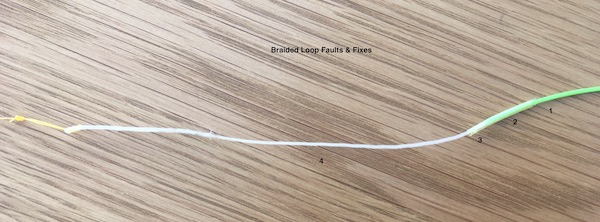
While working with my clients, I see some key faults in the use of braided loops on a regular basis. These faults impact fly presentation and bite detection, so they make a big difference for a small change. The above photo shows the four main faults discussed below along with suitable fixes.

  1. Insufficient fly line has been inserted into the hollow section of the braid, increasing risk of joint failure. I aim to have around two inches (five centimetres) of fly line inside the hollow braided section, ensuring the fly line tip is butted up against the solid looped section of braid (see point four below for more details on this).
  2. Although braided loops are supplied with grip tube suggesting its use is sufficient to fix loop to fly line, it is wise to apply a tiny spot of super glue as insurance against slippage. In the example photo super glue has been excessively used along the length of braid into which fly line has been threaded. This makes for a very stiff joint, liable to cracking and subsequent failure. It also adds excessive weight to the front of a fly line, increasing disturbance when a cast is made and sinking the tip on floating lines. This results in more fish spooking from casting disturbance. For floating line use additional issues caused by line tip submerging are bad presentation of dry flies, poor visual bite detection if watching the fly line and reduced hook up to bite ratio due to increased slack line. A simple cure is to apply just one spot of super glue to the very end of a braided loop’s hollow section before pulling the grip tubing over the join. This action evenly spreads the glue around the braid/line junction, adequately supporting the grip tubing while retaining a flexible, secure and much lighter join which significantly reduces or eliminates problems raised.
  3. Way too much grip tubing has been used to secure the braided loop to the fly line. This adds excessive weight to a fly line’s tip, creating the same weight issues discussed in point two above. The easy fix here is to use a maximum of two centimetres of tubing. The reduced weight again reduces/eliminates problems.
  4. This loop has too much hollow braid prior to the solid looped section, a common fault in commercially made loops. We have a length of hollow braid between the tip of a fly line and the solid loop section shown in the photo. This hinges when casting, resulting in poor turnover of your leader, plus increased disturbance from casting. If the fly line had been inserted along the full length of hollow braid, the hinging issue is removed. However the excessive weight issue remains, resulting in similar problems to those raised in points two and three above. You need no more that two inches (five centimetres) of hollow braid on your loops. If there is more, simply remove it with sharp scissors before connecting a fly line. Problems are solved.

If you find braided loops useful in your fly fishing, I hope the faults and fixes discussed above help you to refine your setup and improve your success/enjoyment of the sport.

Thanks for reading.

SJY

Summer Success!

A quote often associated with summer fly fishing for trout is “the dog days”. I’ve heard this since first becoming interested in fishing as a child. Whilst classic summer conditions do bring challenges after the abundance of spring, success awaits the angler open to change!

Take for example the scene in the above image. The angler pictured was fishing a small bay on a clear lake. A light breeze came and went throughout the morning. He was positioned to cast across this breeze so his fly, a small buzzer appropriate to the naturals around, fished perfectly to cover the bay. He cast and fished well all morning, yet received no reward for his effort, despite his tactics and execution being sound.

Talking with this angler at midday, he mentioned how frustrated he felt about his morning’s fishing and asked what I had used to catch the large trout he had seen me land. What happened next was a huge surprise to him. Instead of showing him a fly as he expected, I played him this short video clip!

I had been fishing/filming with my good friend Don Stazicker that morning. Having noticed the angler opposite fishing as above, we compared the sport we enjoyed throughout the day with his. From our vantage point, trout were clearly visible in the bay the other angler fished with excellent technique. We saw fish react positively to his fly and he did in fact receive several takes. He just did not know it!

Despite fishing a highly productive technique correctly, one key element failed. Bite detection! If you don’t know a fish ate your fly, it might as well not have.

The key difference between success and failure that day had been taking bite detection as close to the fly as possible. I had been casting a fly to sighted fish, watching their reaction to my presentation, setting the hook when I saw the fish actually eat the fly. The other angler had been watching his fly line as it swung in a slight curve across the water, waiting for it to slide away. On this occasion it did not.

Having watched the short video and talked a few minutes more, the angler thanked me, went on his way with renewed confidence and adapted his tactics for the afternoon. You won’t be surprised to hear he caught several fine trout later that day. I think I was even more delighted than he so evidently was!

I hope this helps you too? Thanks for reading.

Steve

3 Fly Fishing Fundamentals for Success

Whenever you go fly fishing remember these 3 key fundamentals and it will, if executed correctly, help you transform your success.

  1. Know where the “active” fish are.
  2. Give the fish what they want, where they want, when they want it, without them knowing you did it.
  3. Know when the fish eats your fly and set the hook successfully.

Note by the term “active fish” I mean feeding/aggressive, highly likely to take. It makes no difference whether you are chasing feeding fish in fresh/saltwater, or non feeding migratory species. The 3 fly fishing fundamentals for success apply in all cases. Get it right and reap the rewards!

Have fun!

SJY

Fly Fishing Tech Hacks Part 3

If you have followed my posts here over time, you will probably realise that most of the time, on most water ways, fish are opportunistic feeders. Put another way, presenting a fly that looks edible, where they want it, when they want it, is a very successful strategy.

However, there are times, when the fly you present the fish with, is critical to them eating it. Often referred to as “selective feeding” the fish are focused on specific food forms or even stages of a given species (e.g. an emerger). It is now that answering the question “what are they eating?” is a must.

Enter Google Lens! This useful app allows you to identify things within an image. So the next time flies are hatching, fish are rising and your best attempts are ignored, try this little hack.

First collect, then photograph the fly with your phone. Second, use Google Lens to ID the fly. Third, perform a quick search for fly patterns to imitate the natural (if required). Search your fly box(es) for a suitable imitation, and commence your assault on the fish.

Is the app 100% correct on identification? No. It is however right more than wrong and often close enough even then. Like other AI applications, this will only get better with time and use. It’s a useful tool for short cutting your learning curve as you develop your own experience. Unlike the options covered in part 1 – creating your own database and part 2 – fish location tools, we are looking here at the minority of situations and a possible solution for when the going gets really tough.

Try it and see if it works for you!

SJY

By continuing to use the site, you agree to the use of cookies. more information

The cookie settings on this website are set to "allow cookies" to give you the best browsing experience possible. If you continue to use this website without changing your cookie settings or you click "Accept" below then you are consenting to this.

Close